TV Series
Before Netflix Drops Season 2: The Best Moments of ‘Interview with the Vampire’ Season 1

Interview with the Vampire Season 2 drops on Netflix September 30th, which means there’s still plenty of time to catch up on the brilliant first season. If you haven’t watched it yet, what are you even doing here? Go hit play and let yourself be swept away by AMC’s lush, haunting, and surprisingly funny take on Anne Rice’s iconic novel and beautifully complex characters.
But if you’re already up-to-date, you know what a gift this first season was. From the perfectly cast characters brought to life by a stunningly talented ensemble, to writing that delivers a delicious blend of Gothic drama, sharp humor, devastating heartbreak, and love so real it aches. Add in costuming that nails every meticulous detail, set design that remains unmatched (I still think about that coffin room on a daily basis), and an SFX team that has brought the horror of blood on screen to high art, and you’ve got one of the most satisfying adaptations we’ve seen in years.
What we do need to do now is revisit the best moments this first season gave us, the moments that made us laugh, cheer, sob, and pause to take it all in. Fair warning: I’m a total sap. I love a happy moment, I love love, and I think those moments matter just as much as the horror. In fact, some of my favorites are happy and horrifying at the same time, which is exactly what makes this series so good.
Maybe I’ll follow this up with a list of the truly horrific moments, because the darkness is just as essential to the story as the love. But, to borrow from Crimson Peak, “The horror was for love.”
Before you keep reading, this is a fair warning: spoilers ahead for Season 1! Yes, it’s been out for three years…but still, you’ve been warned.
There are so many moments I wish I could include here, and perhaps I’ll give them a brief honorable mention at the end. But these moments are some of the best written, best acted, most important moments to the foundation that is AMC’s Interview with the Vampire:
10. “I heard your hearts dancing!”

If you know Louis and Lestat, you know they both have their manic moments, and Season 1 Episode 3 (“Is My Very Nature That of the Devil?”) gives us one of the earliest, and best, displays of Lestat’s mania. The sequence is brilliantly executed: Louis’ festering anger at vampire life, his quiet, unspoken hurt at Lestat’s unfaithfulness, his rage at the relentless racism he faces despite his wealth and power, and his fear of the monster he’s becoming all boil over. And in response? We get Lestat at his worst, lashing out because he’s afraid, being wildly hypocritical, and cutting Louis down (something Louis is very good at reciprocating).
This is the couple’s inability to communicate at its absolute ugliest. It’s an iconic confrontation (iykyk), forcing both men to face not just the infidelity, but the bigger, more painful question of whether Louis can ever bear the life Lestat has long since embraced.
And then comes the moment that takes the scene from emotionally charged to unforgettable which is Lestat’s staggering display of power. What starts as a petty provocation — dragging a group of soldiers into their townhouse to goad Louis — becomes a jaw-dropping flex as he mindfucks dozens of men to march out in eerie, perfect formation. It visibly costs him, but he’s still standing. And the message is clear: Lestat is not a man to be underestimated…and maybe we, the audience and Louis, don’t know him as well as we thought.
9. “To beat Lestat, you have to become Lestat”

The beginning of the end comes at the close of Season 1 Episode 6 (“Like Angels Put in Hell by God”), and it arrives in the form of a chess match. Chess has always been a quiet but crucial motif in Interview with the Vampire — a symbol of strategy, manipulation, and power dynamics — and this match is one of the most important. (In the future we can talk about a one-off, but incredibly important line in The Vampire Lestat that absolutely shapes this whole interaction.)
Coming off Claudia’s horrific runaway attempt (thwarted by Lestat in an act of cruelty so precise it’s almost surgical (fans, I’m going off of what we have canonically and not the unreleased SDCC trailer that we don’t actually know how it plays within the show’s context)), the tension in the townhouse is unbearable. And yet, we see something shift: Claudia is no longer just the clever child vampire, but a strategist, and she’s done with any type of passivity. Lestat sits smug, his quiet confidence radiating as Louis grows increasingly anxious, but Claudia? Claudia is plotting.
What begins as a “typical” chess match between the father and daughter — one that has historically ended with her losing — becomes a full-blown psychological battle. Claudia plays in silence, but speaks telepathically to Louis, revealing piece by piece that she has a plan. Not just a plan to win this game, but a plan to kill Lestat. Louis’ anxiety is palpable as he watches the two of them move pieces across the board, both literal and metaphorical, and as Claudia makes her intentions crystal clear, she drops her most devastating line: Louis wants to kill Lestat too. Or so she says.
When her victory is just within reach, Claudia stops. She refuses to deliver the final move, turns away, and heads to bed. It’s the ultimate power move, and it makes Lestat snap. His roar of “FINISH THE GAME!” shakes the room as he slams a fist on the table and throws the chessboard, the pieces scattering like the fragile illusion of their family. And all the while, over the chaos, the radio plays President Roosevelt’s address announcing America’s entry into World War II, a brilliant, chilling bit of sound design that underlines the critical moment: war is here.
It’s one of the most masterfully executed sequences of the season, tense, quiet, and horribly explosive, and it’s a perfect example of how Interview with the Vampire uses dialogue, body language, and atmosphere to turn a domestic scene into a moment of world-shifting stakes. You can feel Louis’ dread, Claudia’s fury, and Lestat’s growing realization that his power over them is starting to crack. It’s not just a chess game, but the first real step toward patricide, toward regicide.
8. “I was a baby bird…”

Stepping further back into Louis’ story, we have to talk about Louis in his vampiric infancy, a fledgling vampire learning, in real time, how to exist in this new, impossible world. The immediate aftermath of Louis’ turning sends him on a dizzying journey of “death, rebirth, coming out, homicide” — all in the span of one night — in Season 1 Episode 2 (“…After the Phantoms of Your Former Self”).
From the graveyard outside the church to the lively streets of Storyville, from the claustrophobic bar to the new quiet of 1132 Rue Royale and its coffin room, Louis is plunged into a crash course on what it means to live (and kill) as a vampire.
It’s an intoxicatingly overwhelming sequence, one built on sensory overload. Being a vampire isn’t just about drinking blood — it’s about feeling everything turned up to eleven. We can feel what Louis feels: the hum of electricity buzzing, the blood pounding in every living vein around him, the dizzying beat of music and chatter spilling from Storyville. We can see the sweat glistening on human skin under gaslight, smell the acrid curl of cigarette smoke in the air, sense the sharp tang of fear on the salesman as he realizes he’s about to become a meal. We can feel the weight of Lestat’s gaze — not just joy, but near-rapturous pride — at having made a companion, and we can feel the scorch of the sun from Louis’ one ill-fated step into daylight. And most of all, we can taste the blood in the back of Louis’ throat, heavy and metallic, as horror and hunger fight for dominance.
Director Alan Taylor (whose credits include Game of Thrones’ pilot episode, Thor: The Dark World, and The Sopranos) frames this first night with sweeping intimacy and Gothic precision. Every shot is drenched in atmosphere and the camera lingers on the intimacy between teacher and student. The simultaneous eroticism of Lestat guiding Louis through his first kill and the terror of Louis realizing what he has become creates a haunting dichotomy. It’s beautiful, it’s horrifying, and it sets the tone for the entire series: love and horror are inseparable.
7. “Dear new diary,…you’ve joined a happy home…”

There’s a moment so brief and so achingly fleeting, a moment when everything in Louis and Lestat’s world feels right. It happens a little less than halfway through Season 1 Episode 4 (“…The Ruthless Pursuit of Blood with All a Child’s Demanding”), and it’s one of the most luminous sequences in the entire series. With Claudia newly turned, she seems the missing piece in their volatile “marriage,” a daughter who settles the storm between them. For a heartbeat, their little family looks whole.
The show gifts us two minutes of pure happiness, anchored by Claudia’s diaries and stitched together in a montage that radiates with joy. We see Claudia’s freshly renovated bedroom, her pink coffin tucked behind a revolving wall, bed on the other side like the perfect teenage compromise. There’s a birthday party, candles flickering on a cake, paper hats perched absurdly on vampire heads. A necklace with a bloody history (literally — its last owner lost theirs) is given as a treasure, and the party gifts? Three bodies, wrapped up for dinner, later burned in their incinerator. The grotesque and the tender hold hands seamlessly here.
Then, a dance: Lestat twirls Louis in a dance out in their courtyard, the two of them smiling in a way we almost never see, soft and unguarded. Claudia, watching with the same awe we feel, joins in, and the three become a laughing ring of dancers under the night sky. Later, they sit together at the movies, cackling in a public theater at Nosferatu’s absurd vampire lore, delighting in their own private joke as the audience around them squirms.
It’s domesticity, it’s intimacy, it’s pure. And it’s utterly unbearable. Because the brilliance of the sequence isn’t just in the happiness it captures, but in the shadow that hangs over it all. We know, even as we watch, that this is the peak. That they will never again be this close, this safe, this human. For two minutes, immortality looks like bliss. And the tragedy is knowing it will never be like this again.
6. “We want to throw a Mardi Gras ball.”
How else could a season set in New Orleans end but with the most unhinged, operatic Mardi Gras imaginable? Season 1’s finale gives us a sequence that’s not just spectacle, but a whole story, a beautiful mix of writing, performance, costuming, and design that work in perfect, dreadful harmony.
By now, New Orleans has grown suspicious of the never-aging family at 1132 Rue Royale, and the vampires know their exit is overdue. But the audience knows what Lestat doesn’t: Louis and Claudia have already decided the only way forward is to kill him. Mardi Gras becomes their honey trap. Claudia plots, Louis distracts — except Louis’ distraction is doomed to fail. Because the closer he gets to Lestat, the more he finds himself falling in love all over again.
The family starves themselves for days beforehand, saving their hunger for a final euphoric feast. By the time the party arrives, they’re lightheaded, vibrating with anticipation. And then Mardi Gras explodes onscreen: a ball of excess and menace, climaxing in Lestat’s grotesque, unforgettable entrance as Raj, King of Mardi Gras. His devouring of a baby (hello, Saturn Devouring His Son) shocks the crowd into silence and solidifies his role as both host and monster.
Every beat of the sequence deserves attention, but two moments tower above the rest. The first was almost lost, a quiet balcony scene between Louis and Lestat nearly scrapped due to a sound issue, miraculously reconstructed by the post-production team. And I’m eternally thankful it was saved, because what Sam Reid delivers here is nothing short of extraordinary. In a single unbroken take, he gives us the most vulnerable, human Lestat of the season: eyes shining with longing, voice breaking with memory, pauses weighted with regret. You can watch entire emotional monologues flicker behind his gaze before he even speaks. It’s a masterclass in restraint and intensity, the kind of performance that elevates the scene from “memorable” to “indelible.”
And then comes the scandal of scandals. Not murder, not agelessness, but a dance. Louis and Lestat take each other’s hands and move as lovers across the floor, twirling, smiling softly, unguarded. It’s a callback to their courtyard dance with Claudia, but now it’s public, undeniable, and impossible to ignore. Over this, Louis’ present-day narration laces through the scene, delivering one of the most romantic lines of the series: “I was his, and he was mine.”
It all crescendos in a kiss, both a declaration and a farewell. In front of the city they’ve haunted for decades, Louis and Lestat bare themselves completely, for one perfect, damning moment.
5. “I’ll let you reload.”

Louis de Pointe du Lac endures more than his share of humiliation at the hands of New Orleans society. From the very first episode, despite his wealth, hard work, and sharp business sense, he’s treated as lesser by the white men he’s forced to deal with — underpaid, dismissed, and targeted simply for being Black and successful. He swallows it again and again, until Season 1 Episode 3 (“Is My Very Nature That of the Devil?”) pushes him past breaking point.
The Azalea — the brothel Louis bought from Tom Anderson and turned into a thriving business — suddenly finds itself besieged by laws that white-owned establishments never face. And Louis, recognizing the game is rigged, decides to stop playing. He takes the one power his turning has given him and turns it outward: terror.
The sequence begins with Louis arriving at Alderman Fenwick’s home, a smarmy politician who has long been a condescending presence in Louis’ life. Louis is silent, unsettling, and, once choosing to, moving with predatory speed. Fenwick postures, sneering about Louis’ place in the world, but it all unravels the moment Louis stands and softly asks, “Why’s your heart beating so fast?” The question lands like a strike, exposing Fenwick’s fear even as he scrambles for his gun.
Two bullets slam into Louis’ chest. He barely looks down at the holes torn in his blood-red suit before goading the man on with a bored, unphased, tone to his voice. What follows is a scene of utter brutality. Louis digs into the man’s thoughts, the sound of Fenwick’s racing heartbeat pounding in our ears. Then, with meticulous precision, he unleashes: ripping an ear from Fenwick’s head, dragging claws across his face, plunging a fist into his chest cavity so hard blood spatters across Louis’ own face.
And then comes the declaration, an unforgettable moment for all of us that have been watching Louis’ battle with his own nature: “I’m a vampire.” His fangs descend, and Louis lunges, the camera catching the sharp, terrifying silhouette of his mouth in motion.
What follows is abject horror as we see Fenwick’s body displayed in Jackson Square, entrails strewn like grotesque confetti, a mocking sign draped across him reading “Whites Only.”
Jacob Anderson is remarkable across both seasons of Interview with the Vampire, but this scene is a crown jewel. Louis is often tightly coiled, repressing his fury and grief, but here, we see what happens when that repression shatters. Anderson plays it with icy precision, unleashing terror with calm, unhurried menace. It’s horrifying, it’s cathartic, and it’s a reminder that Anderson’s Louis isn’t just a victim of the world around him. He is also capable of being its nightmare.
4. “Do you think two pair will win the hour?”

The poker match in Season 1 Episode 1 (“…In Throes of Increasing Wonder”) was the very first full scene AMC released ahead of the show’s premiere and with good reason. It’s magnetic from start to finish.
After their tense first meeting at Tom Anderson’s Fairplay Saloon (we really need to have a separate conversation about how smooth Lestat was in that scene), Louis and Lestat cross paths again, this time at a poker match hosted by Tom. Louis, invited as a respected businessman, is there on legitimate business. Lestat, on the other hand, has clearly inserted himself into the game the moment he caught wind of the gathering because where Louis is, Lestat will be.
The scene opens with Louis’ arrival — devastatingly gorgeous and all quiet charisma — as we catch snippets of the men already seated, gossiping about a mysterious new disease sweeping the city (a chilling bit of foreshadowing, given the story to come). Lestat, ever the provocateur, tosses out a joke about the deaths, and just as the table laughs, Louis steps inside. Their eyes meet, and from that moment on, Lestat doesn’t look away.
Tom Anderson introduces them, but Louis’ soft, pointed, “We’ve already met,” hangs in the air like a challenge. Even without those words, it’s obvious something is already sparking between them because the chemistry is electric. This is the moment you know, without a doubt, that Louis and Lestat are going to become the most intoxicating, destructive, magnetic couple imaginable. Jacob Anderson and Sam Reid lock eyes and suddenly the entire room feels too small to hold them.
Then the scene turns. The conversation shifts to business, and Louis, the only Black man at the table, is subjected to the casual racism and disrespect that has marked his entire existence. He swallows it, silent but visibly angry, and it’s here that Lestat makes his move.
Instead of defending Louis aloud, Lestat shows him something more intimate, more staggering: his vampire nature. While the other men blather about business, Louis hears Lestat’s voice in his head telling him what really matters: that Lestat sees him, values him, and knows his worth in a way these men never will.
And just when the moment couldn’t become more extraordinary, Lestat stops time itself. The poker table freezes — cards suspended midair, drinks paused mid-pour — in a stunning display of practical effects that feels like pure magic. He steals a card from Tom Anderson’s hand, slipping it to Louis so that he wins the game.
This is the moment their relationship truly begins, not as lovers yet, but as co-conspirators, friends, and equals in a way Louis has never experienced with another person. It’s romantic, thrilling, eerie, and charged with so much possibility that you can practically feel the ground shift under Louis’ feet. It’s the first time he sees what life with Lestat could be like, a life that’s dangerous, yes, but also liberating, and you can see Louis’ walls start to crack.
3. “I had a daughter.”

There’s so much devastation woven into the present-day interview, and so much we still don’t know by the end of Season 1, but one truth stands above all: Claudia is gone. And she’s been gone for a very, very long time.
Season 1 Episode 4 (“…The Ruthless Pursuit of Blood with All a Child’s Demanding”) is our first real glimpse at the family Claudia became with Louis and Lestat, and our first taste of the grief left behind in her absence. For most of the episode, Daniel serves as our surrogate, reading Claudia’s diaries and guiding us through the rise and fall of their little family. And then, near the end, as Daniel reaches the turning point in Claudia’s story — the death of her first love, the moment Lestat’s cruelty becomes undeniable — modern-day Louis finally rejoins the interview.
What follows is one of the quietest but most devastating moments of the season. This older Louis, colder and more controlled than the Louis we’ve come to know, sits down with an almost surgical precision. And then, for just a flicker of a moment, we see his composure slip. His expression softens, becomes wistful and haunted, and in a voice that sounds like grief given shape, he says:
“Claudia was…everything. I loved her unconditionally. All the noise, the chaos, the crisis of my former existence, silenced. The simple joy of her hand in mine.”
And then comes the gut-punch. Daniel, also older now, sharper, more willing to call Louis out than he was in 1973, says something so simple, so direct, it knocks the air out of you:
“You had a daughter.”
Louis repeats it, softly, almost reverently:
“I had a daughter.”
It’s a moment that stops you cold. This isn’t about vampiric bonds or gothic melodrama; this is a father speaking about the child he loved and lost. Jacob Anderson’s performance here is breathtaking, so restrained, so precise, and yet so achingly human that you can feel the centuries of grief pressing down on him. It’s a rare crack in Louis’ carefully maintained armor, and it reminds us, and Daniel, that this interview is not just about getting answers. It’s about opening old wounds, wounds that have never fully healed.
2. “You spared him out of some fucked-up idea you had about love!”

The finale of Season 1, Episode 7 (“The Thing Lay Still”) delivers the (sort of) success of Louis and Claudia’s plan: the death of Lestat. It’s something we’ve known was coming, something we’ve watched slowly build step by step with mounting dread, and something we’ve watched Louis want less and less the closer it gets.
When it finally happens, it feels like watching a car crash in slow motion. Even when Lestat appears to have outsmarted them, to have been three steps ahead all along, Claudia reveals that she was four steps ahead.
The lynchpin of the plan was simple but chilling: get Lestat to drink poisoned blood. Both Louis and Lestat believed that blood would come from a random victim Claudia had trussed up as a gift. But Claudia knows her father’s heart too well. She poisoned Tom Anderson, a man who had mocked Lestat’s Mardi Gras ambitions and who had long been a thorn in their side.
This reveal comes on the heels of a harrowing series of events which include the family’s twisted bonding massacre at the Mardi Gras afterparty, the chilling reveal that Antoinette (Lestat’s mistress) has been turned and spying for Lestat, and the brutal near-altercation where Lestat pins Louis back as Antoinette tries to force Claudia to drink the poisoned blood herself.
And then the trap snaps shut. Lestat vomits blood, the poison already burning through him. Louis looks wrecked.
Lestat collapses, Louis clings to the wall as though he could melt into it, and Claudia, ever the pragmatist, incapacitates Antoinette and delivers the coldest of mercies: “Have your goodbyes.”
And suddenly, it’s just the two of them again.
Lestat calls Louis’ name, guilt and grief and poison all mixing together in a cocktail of pain, and Louis — who clearly does not want this, who has never truly wanted this — finally takes up the blade he’s carried since his human days and kneels beside the man he loves.
What follows is one of the most agonizingly beautiful sequences in the entire series. What should be murder becomes intimacy. Louis gathers Lestat into his arms as though he could hold him together, and Lestat, still utterly devoted to him, leans into this last embrace.
His words are a quiet dagger of their own:
“We are joined by a cord, by a cord that you cannot see, but it is real. It is real… I have loved you with all myself. I’m happy it was you here with me…at the end.”
Louis’ face says everything: the grief, the horror, the unbearable love that still lives in him even as he takes Lestat’s life.
And though our modern-day Louis tries to shrug this off as just another part of the story, Daniel sees right through him, and his pointed observation breaks something open.
We get one last glimpse of the real aftermath, the smallest look of Louis clutching Lestat’s body, screaming in raw, wordless despair. It lasts only a second, but it is shattering.
Once again, Jacob Anderson and Sam Reid prove there is simply no one doing it like them on television. In this scene alone, they deliver more talent in a single glance, a single waver of a lip, than some actors could dream of capturing across an entire career.
Separately, they are both powerhouses; Anderson’s Louis is a masterclass in interiority, every movement a study in restraint, every flicker of his expression revealing a storm of love, grief, and guilt barely contained beneath the surface. Reid’s Lestat, by contrast, is all magnetism and chaos, an electric storm of charm, danger, and raw vulnerability.
But together? Together they are something volcanic. They are magnetic, devastating, impossible to look away from, and not just as acting partners but scene partners who seem to rewrite the air around them when they share a frame. Every look, every touch, every pause between them is freighted with history, desire, rage, and devotion. It feels less like watching two actors perform and more like watching two souls collide over and over again.
1. “…and we sat there for some time, in throes of increasing wonder.”

I haven’t stopped thinking about this scene since the moment I first saw it on September 29, 2022.
This is The Moment. It is, as Louis says after recalling it, “The end. The beginning.” It’s everything that makes Interview with the Vampire what it is.
There are two monologues in this scene — one from Jacob Anderson’s Louis and the other from Sam Reid’s Lestat — and both are nothing short of transcendent.
The scene begins after Louis has suffered the greatest loss of his human life: the death of his brother Paul. The grief itself is immeasurable, but paired with his mother’s blame, his fear of his own desire for Lestat (which wars with his Catholic upbringing), and the endless strain of keeping his family afloat as a Black man in Jim Crow New Orleans, Louis is at his lowest. And where else does one go when lost, if not to a church?
Stumbling through the storm, Louis enters St. Augustine’s, the church of his youth and of Paul’s peace. The priest takes him in, and soon Louis is in the confessional, pouring out his shame, his guilt, his suicidal despair.
Jacob Anderson delivers this monologue with such raw vulnerability that every tremor of his voice feels like it shatters inside you. The way he builds from quiet shame to breaking desperation is unforgettable and is the kind of performance that deserves every award in existence. What makes Anderson’s performance so striking is how restrained yet devastating it is. He doesn’t overplay Louis’s anguish. He embodies not only Louis’ suffering, but also his humanity, his fragility, and the sheer weight of a life lived under impossible pressures. It’s the kind of layered acting that makes Louis feel less like a character and more like a living, breathing person unraveling before our eyes.
And then, in the middle of the storm, the walls rattle. The priest screams. A shadow tears him away.
Sam Reid storms onto the screen in this moment as if he’s been waiting an eternity for it. His Lestat is terrifying — feral, blood-soaked, larger than life — and yet within minutes, he transforms seamlessly into something else entirely, the world’s most desperate lover. It’s a whiplash performance in the best way possible, capturing Lestat’s danger, his arrogance, his recklessness, and finally his aching, earnest need for Louis.
And it isn’t only his voice that sells it, it’s his physicality. Reid uses his body with the precision of a dancer: the way he looms, all predator and menace, then softens his shoulders when he approaches Louis; the near-reverent way his hands reach, hesitant and trembling, as if he’s afraid this fragile moment might break; even the slight tilt of his head as he delivers his declaration, like he’s both begging and commanding at once. Reid embodies Lestat not just with words, but with every inch of himself.
“Be my companion, Louis. Be all the beautiful things you are, and be them without apology. For all eternity.”
Delivered in Reid’s voice, paired with that piercing physical stillness, those words aren’t just a line of dialogue, but the words that surround the entirety of the story we watch for the next two seasons.
And what makes this even more powerful is the contrast between the two men. Jacob Anderson plays Louis inward, shoulders drawn in, voice breaking, body language locked in grief. Sam Reid plays Lestat outward, expansive, magnetic, reaching, pulling everything in his orbit. And when they finally kiss at the altar, those two opposing physicalities collide. Louis’ inwardness meets Lestat’s outwardness, and the result is electric.
The kiss is not just blood and horror. It is relief. It is desire. It is Lestat’s shoulders finally dropping, Louis’s trembling acceptance, and love above anything else.
Jacob Anderson and Sam Reid, together in this scene, achieve something extraordinary, bringing to the screen the perfect balance of eroticism, horror, romance, and fear. Any one element could have tipped too far and ruined it, but instead, they make it one of the greatest love scenes in television history.
This scene will change you. It’s a duet of performances so perfectly in sync that it becomes impossible to imagine this series existing without the alchemy of these two actors at its center.
These ten moments are only the beginning. Interview with the Vampire is overflowing with scenes that haunt, seduce, horrify, and move you in equal measure, and it would be impossible to capture them all in a single list (seriously, narrowing this down was torture). If you haven’t yet given this series a chance, consider this your invitation, consider this my plea. It’s a show that doesn’t just entertain but transforms, lingering long after the credits roll. And if you have watched it, I hope this reads like a love letter to a first season that changed television, a note of kinship from one obsessed soul to another, bound together by the wonder (and ruin) of Louis and Lestat’s story.
And the best part? This is only where their story begins. Season 2 promises higher stakes, deeper heartbreak, and the kind of writing that continues to prove why this adaptation is already hailed as one of the most stunning on television. Jacob Anderson and Sam Reid remain nothing short of extraordinary, two actors at the peak of their powers, perfectly attuned to the nuance, danger, and aching romance at the heart of Anne Rice’s world. Their chemistry, coupled with a script that balances horror and beauty, gives us a love story so devastatingly perfect that it will haunt and thrill you long after you step away from the screen.
So mark your calendars: Interview with the Vampire returns to Netflix on September 30th. Whether you’re watching for the first time or revisiting with familiarity, prepare to fall into a world of obsession, desire, and immortality all over again.


TV Series
Breaking Down the First Minute of ‘The Vampire Lestat’ Official Trailer: What It Reveals About Season 3
It’s been two weeks since AMC/AMC+ released the long-awaited trailer for The Vampire Lestat, the third season of their critically acclaimed Interview with the Vampire series, and in that time, a lot has happened.
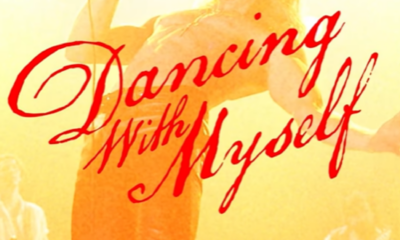
The trailer has already racked up nearly six million views on YouTube, a once-in-a-lifetime concert event has been announced, and we here at iHorror have even broken down what the use of a cover of Billy Idol’s “Dancing With Myself” might signal for Lestat de Lioncourt (Sam Reid) this season.
If you’re just joining the Beautiful Unwell — yes, that’s the official name of the fanbase, courtesy of showrunner Rolin Jones, and one Lestat himself seems to have embraced across his recent Spotify bios, so we’re rolling with it — here’s the quick rundown.
AMC first premiered Interview with the Vampire in October 2022, starring Jacob Anderson and Sam Reid as Louis de Pointe du Lac and Lestat de Lioncourt, respectively. Alongside them, Assad Zaman (Armand), Eric Bogosian (Daniel Molloy), Bailey Bass (Claudia in Season 1), and Delainey Hayles (Claudia in Season 2) have helped shape one of the most critically acclaimed television runs in recent years, with both seasons earning near-perfect scores on Rotten Tomatoes and cultivating a fiercely devoted fanbase.
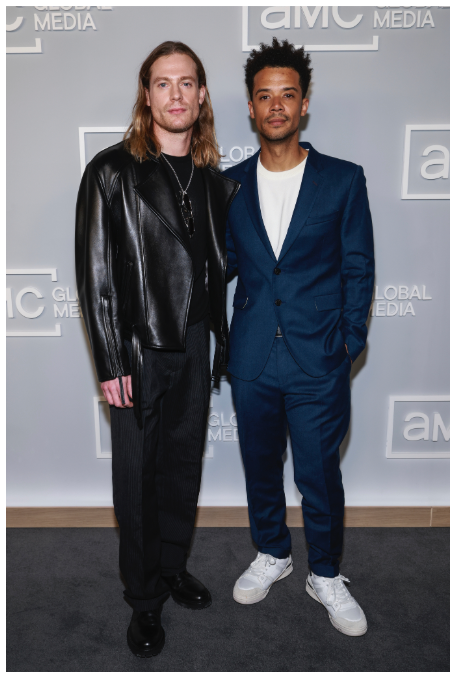
Photo credit: Ben Hider/AMC Global Media
The first two seasons adapt Anne Rice’s 1976 novel Interview with the Vampire, the book that launched The Vampire Chronicles. Now, with the story moving into the second novel, The Vampire Lestat (1985), the series is evolving with it, something AMC made official at San Diego Comic-Con 2025 when they announced the title change to reflect the shifting narrative focus.
Production on Season 3 ran from June through October 2025, with early footage debuting at New York Comic Con before hitting AMC’s social channels. Now, with the June 7 premiere just weeks away, the rollout is in full swing — and the trailer is our biggest glimpse yet at what’s coming.
And there’s a lot to unpack.
Clocking in at just under two minutes, the trailer may be brief, but it’s dense, chaotic, and packed with moments that feel tailor-made for both longtime readers and newer viewers. So naturally, we’re going to break it all down.
But rather than cramming all of that into one piece, we’re narrowing the scope. This is a breakdown of the first minute of the trailer because somehow, even sixty seconds is packed with enough to warrant its own deep dive.
If you’re new to the series, or unfamiliar with the books, I’ll keep things as accessible as possible, and link out to a few previous pieces to help fill in the gaps. And if you haven’t caught up yet, both seasons are currently streaming on AMC and Netflix. Just saying. Again.
“You’ve been alive and undead for 265 years. You witnessed the French Revolution, the electric light, the atomic bomb.”
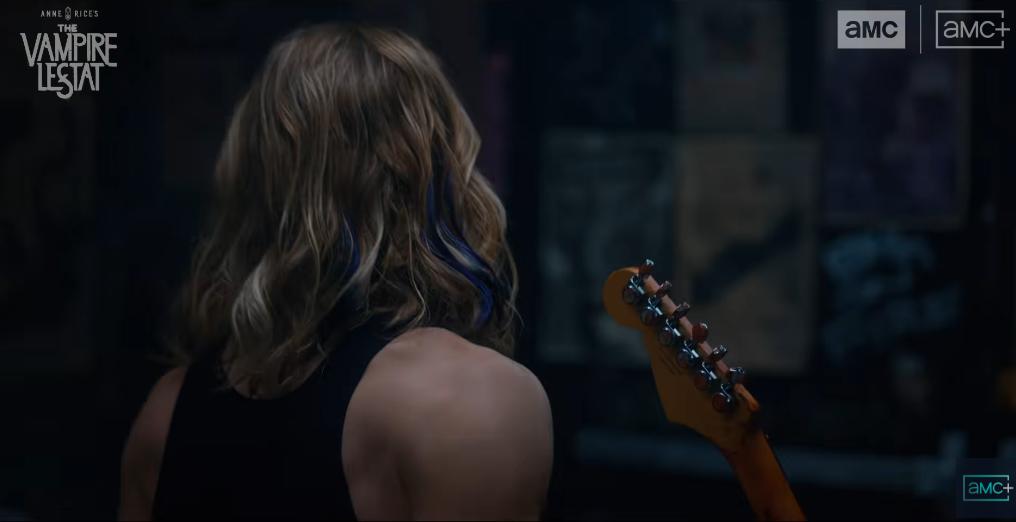
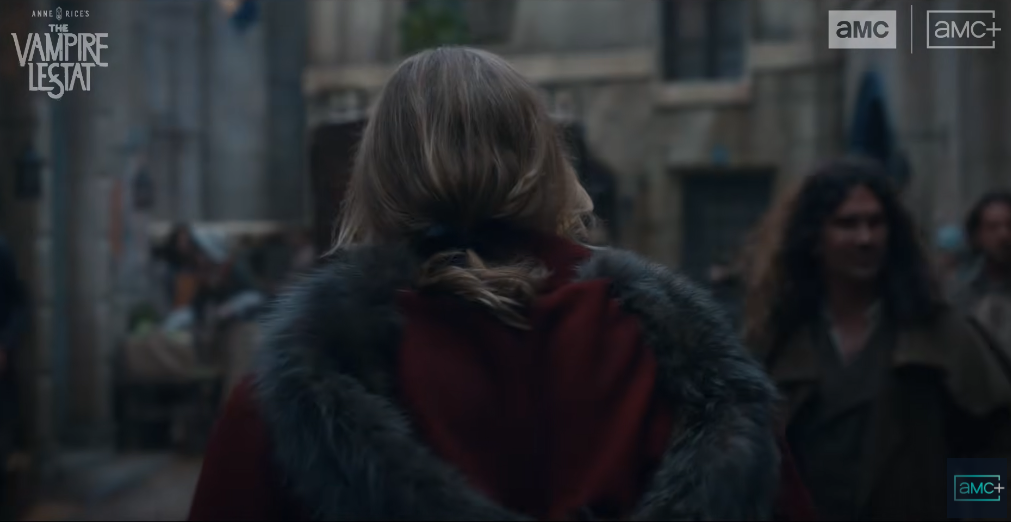
These are the opening lines of the official The Vampire Lestat trailer, delivered by Daniel Molloy (Eric Bogosian) over a striking image of Lestat de Lioncourt (Sam Reid): blue streaks cutting through his blond hair, a guitar in his hand, and boots stamped with the words “Hate” and “Me.”
Then, in the middle of that image, there’s a cut just as Daniel says “French Revolution.” We see Lestat again, but this time in the 1700s. Human and standing in daylight while draped in the now-iconic red wolfkiller cloak.
Honestly, the combination of it all sent chills down my arms.
Because that cloak isn’t just a costume detail, as any book reader knows. It’s a marker of transformation. Even in its brief appearance in Season 2, it carries the weight of two of the most defining — and devastating — moments of Lestat’s human life: the killing of the wolves and the subsequent chain of events that ultimately leads to his turning into a vampire.
If we read Lestat’s origin through the lens of the Hero’s Journey, the wolf attack is his crossing of the threshold. It’s the moment everything fractures. It alters how his family sees him, how he sees himself, and what his future can possibly be. His brief “Golden Moment” curdles into a “Dark Moment” (49), igniting a self-crisis that drives him from home to Paris, the wolfskin cloak on his back acting as both proof and burden.
And it’s there, in Paris, that his fate finds him.
So to see that cloak worn by a human Lestat, in daylight, cut against images of his modern, vampiric self really drives home that we are witnessing a collapse of centuries into seconds, drawing a direct line between who Lestat was and what he’s become.
It also makes one very important thing clear: we’re getting more than just a rockstar; we’re getting a full, centuries-long story.
And, at this point, we’re only twenty seconds into the trailer.
What follows this, however, is something instantly recognizable for book fans: Lestat’s signature introduction.
“I am the vampire Lestat.”
If you’re newer here, that line isn’t just a throwaway, but a pattern. Across The Vampire Chronicles, Lestat frequently opens his narratives by announcing himself in exactly this way, usually followed by something equally on-brand, such as a reminder that he’s hot, infamous, and, at one point, a rockstar. It’s all very Lestat, and he does it all the time.
The original The Vampire Lestat (1985) opening is the most iconic version of this, and we’ve already seen Sam Reid bring it to life in a video that aired at SDCC 2024. But here, the trailer gives us a condensed, modern twist on that same energy.
“It’s my era. I’m a rockstar now.”
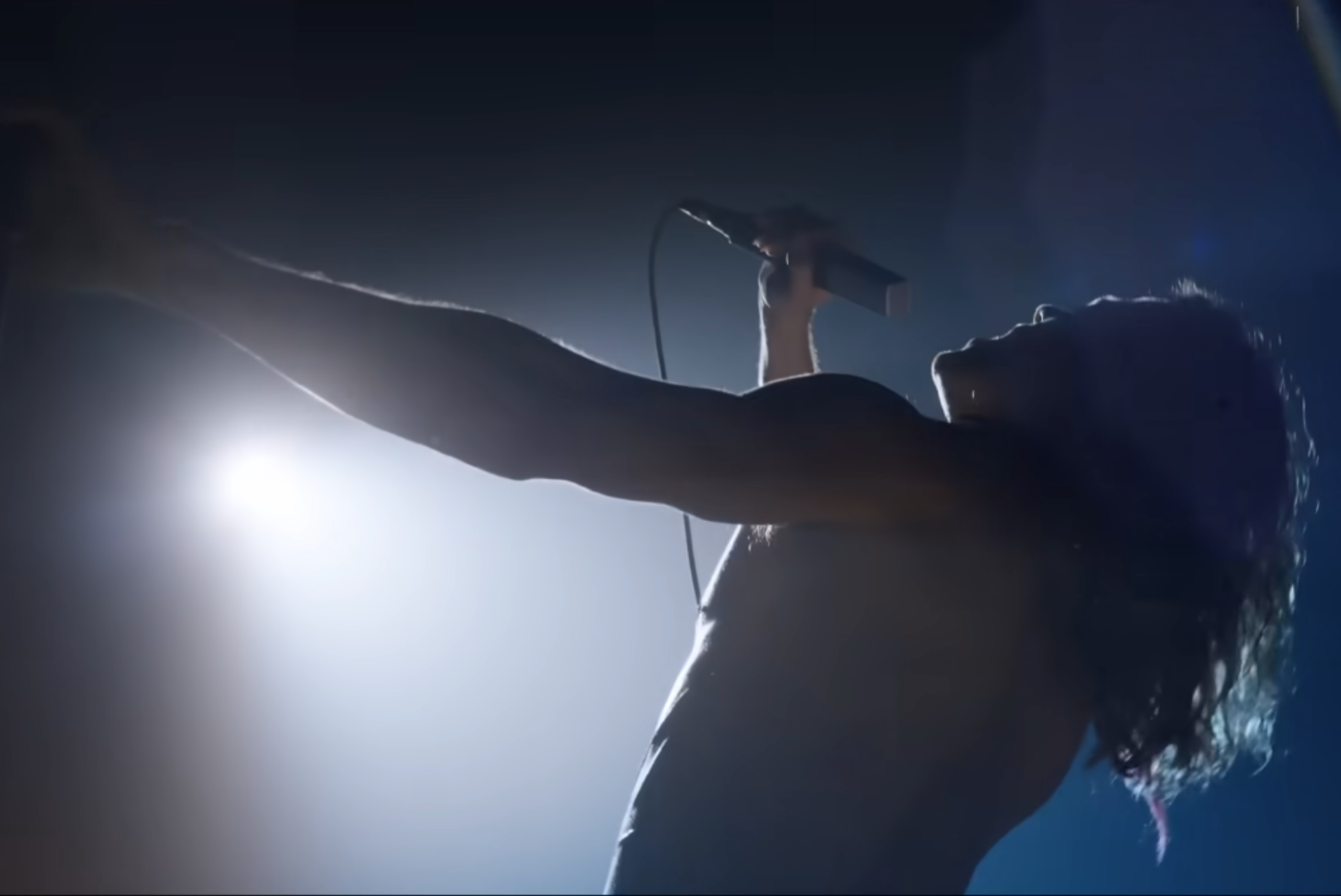
The drums kick in, and the dialogue gives way to Lestat’s cover of Billy Idol’s “Dancing With Myself.” Until the next line breaks through, the trailer leans heavily into concert imagery, but those visuals carry just as much narrative weight as the dialogue that came before.
Nearly all of this initial footage centers on a notably shirtless Lestat, with the first shot alone slowly panning up his body as he stands behind the microphone on stage. And don’t get me wrong — I am very grateful. But this kind of hypersexuality isn’t just aesthetic. If you know anything about Lestat, or have listened to Sam Reid in previous interviews, hypersexualization is definitely a response. So what we’re seeing is a performance, one rooted in control, in image, and in the lingering weight of past trauma.
It tells us that this rockstar era he’s in might not just be indulgent. It very likely is guaranteed to be something devastating.
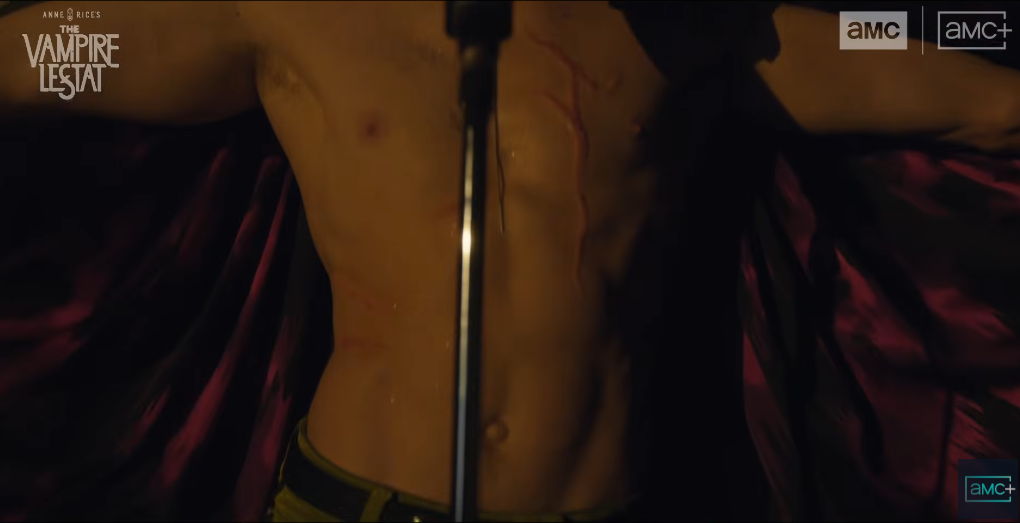
“Thousands of fans love you.” “I want millions. Billions.”
Though the concert footage continues, the trailer briefly shifts, cutting to a disoriented, clearly drugged-up-in-stereotypical-rockstar-fashion Lestat in a quieter moment. He’s speaking to someone just off-screen.
Claudia.
Or rather, the ghost of her.
For both show watchers and book readers, this isn’t unexpected. Claudia’s presence lingers long after her death, haunting both Louis and Lestat throughout The Vampire Chronicles, most notably in The Tale of the Body Thief (1992) and Merrick (2000). And in the series, her death in Season 2, Episode 7 (“I Could Not Prevent It”) serves as the emotional catalyst for everything that follows, including the very interview itself.
So while we’ve always known Lestat would be haunted by his past, it’s hard to imagine a presence more shattering than Claudia.
Because her death is, in many ways, his failure.

We’ve already seen the weight of that failure and, more importantly, we’ve felt it, particularly in Season 2, Episode 8 (“And That’s the End of It. There’s Nothing Else.”). In that final reunion, Sam Reid and Jacob Anderson deliver one of the series’ most emotionally charged scenes. Every line lands with years of history behind it, every look carries so much that has been unsaid, and the result is one of the most emotionally brutal moments the series has delivered.
It’s also where the show proves exactly why it works as well as it does: when Reid and Anderson share the screen, there’s an intimacy and volatility that feels almost unbearable to watch. They expose one another in a way that feels like you, as the audience, are intruding.
And this season looks ready to push that even further, both individually and together.
As for Lestat and Claudia, their relationship has always been complicated, shaped by control, resentment, and rebellion. His rigid, patriarchal role in their household — especially in those latter years — only deepened the fracture between them. And if the trailer is any indication, Season 3 will finally turn that lens back on him.
Because in revisiting his past, we may see how Lestat first learned that behavior himself and how he became the very thing he once hated.
“Come in the great hall and play chess with your father.” (The Vampire Lestat, 29) (Iykyk)
“Why music? Why now?”
Daniel’s questions play over a brief but loaded image, one we first saw in the IGN exclusive clip from February 2025 which showed us Lestat walking past a bookstore, only to stop when he sees Interview with the Vampire displayed in the window.
And that image alone carries a lot of weight because it operates on two levels: Louis, and Lestat.
From Louis’ perspective, it calls back to Season 2, Episode 5 (“Don’t Be Afraid. Just Start the Tape.”), and the original 1973 interview. As we learn throughout that episode, much of that conversation was lost due to Armand’s interference, only rediscovered when Louis and Daniel begin piecing it back together. One thing that came to light in this rediscovery was an almost solely one-sided conversation between Louis and Armand after Louis had gone out into the sun, attempting to end his life after the overwhelming grief of Claudia became too much.
Armand questions Louis about the initial interview, asking him:
“Did I catch you in a fantasy, where [Daniel] somehow fumbles his way to publication? Where Lestat strolls past a bookstore, your book displayed in the shop window, where he buys himself a copy, reads your nasty embellishments and comes chasing after you again? If you want the insanity back, if you wanted escape from this prison of empathy I’ve locked you away in, all you had to do was ask, Louis.”
And now? That’s exactly what we’re seeing.
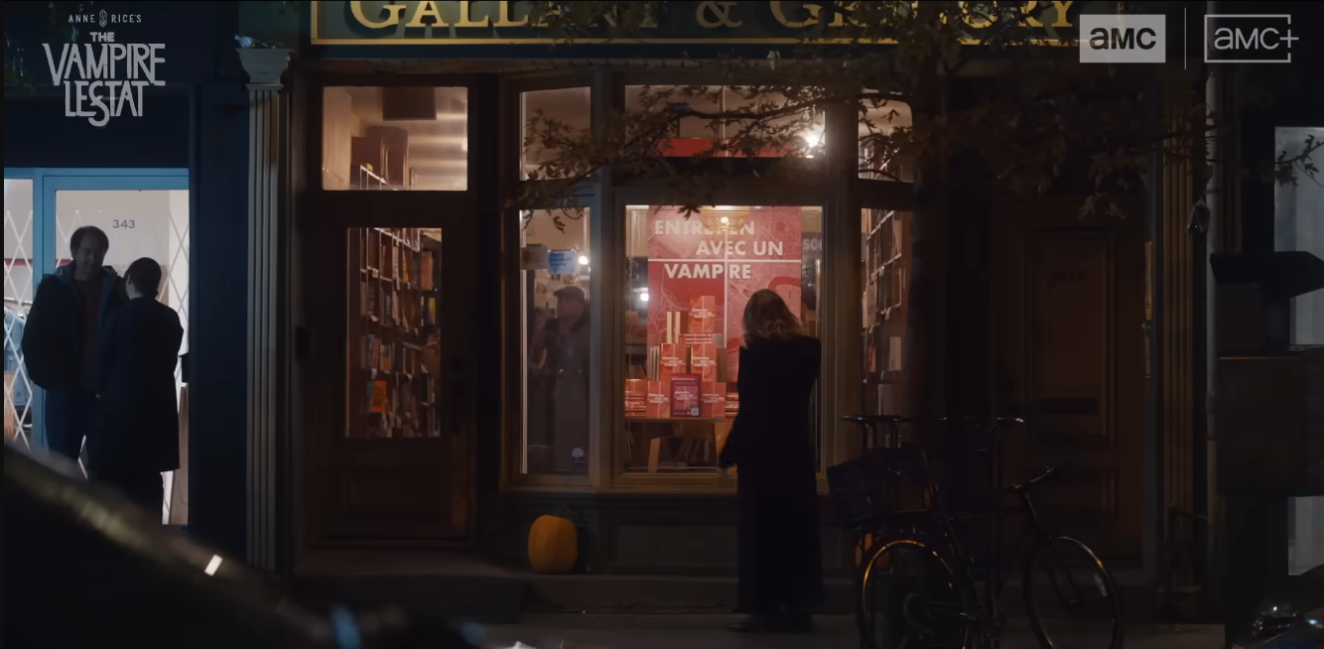
Lestat, strolling past a bookstore. Seeing the book. Reading it.
Oh, it’s poetic.
But it’s also a direct lift from The Vampire Lestat, and the moment that launches everything into movement.
In the novel, Lestat discovering Louis’ book is catalytic. It’s what drives him to step into the spotlight, to form the band, to tell his version of the story. And not just out of ego, but out of urgency.
Because, ultimately, he’s afraid for Louis.
There is one rule almost all the vampires have continuously abided by over the years, and that is the rule which states to not tell mortals about vampiric existence. Louis having not only told a mortal, but that mortal then publishing a book about it, is a major problem.
As Lestat himself says on page 14 in the novel:
“Regardless for what [Louis had] done, others would surely hunt him down… All the more reason for me to bring the book and the band called The Vampire Lestat to fame as quickly as possible. I had to find Louis. I had to talk to him. In fact, after reading his account of things, I ached for him…”
So, yes, this rockstar era is going to be a show. But at its core?
It’s about Louis.
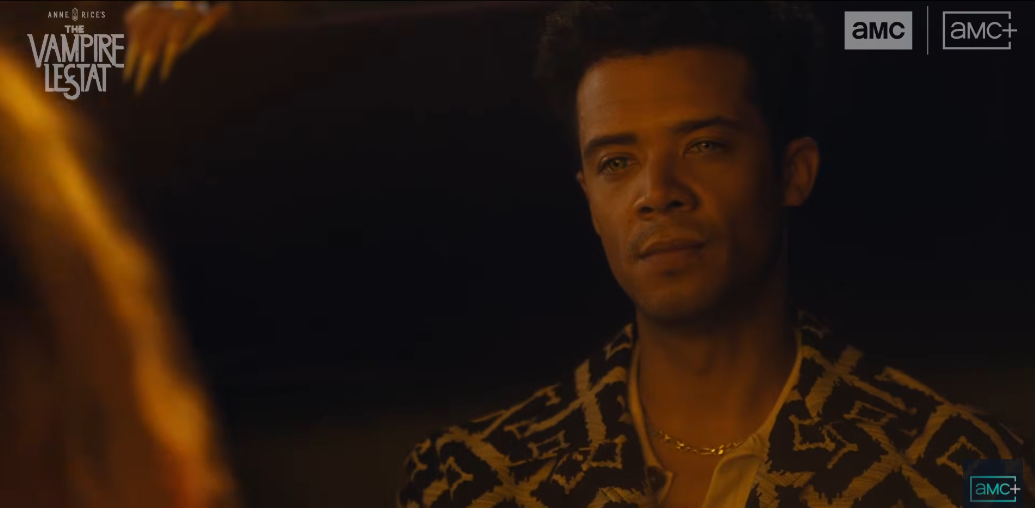
And that brings us to the next line in the trailer:
“We’re doing a rewrite.”
Now, there’s a lot of complexity here.
It’s important to remember, first and foremost, that Louis did not want this interview published and is also upset by its publication. Jacob Anderson confirmed this at the AMC Upfront event on April 29, but it’s something that is quite clear in the narrative already established by the show.
Then there’s outside interference. The Talamasca — the secretive organization tracking supernatural activity — has already had a hand in shaping what makes it to print, meaning the version of Interview with the Vampire that exists in-universe is not untouched.
And even beyond that, it’s incomplete.
As we see in Season 2, Episode 8 (“And That’s the End of It. There’s Nothing Else.”), Daniel stops recording before the full truth of Louis’ life with Armand is revealed, before the fact that their relationship of 77 years was built on a seismic lie is spoken aloud. Which means that truth never makes it into the book at all.
So whatever Lestat is responding to, it isn’t the whole picture.
But more importantly, his version doesn’t erase Louis’. Memories are subjective. Louis’ truth is as true as any truth, as is Lestat’s.
That means this “rewrite” isn’t about erasing what Louis said, but rather confronting it. And in doing so, Lestat will have to face everything he’s avoided — his own past, his own pain, and the moments where he was a victim and also the one causing harm.
And none of that is going to be pretty.
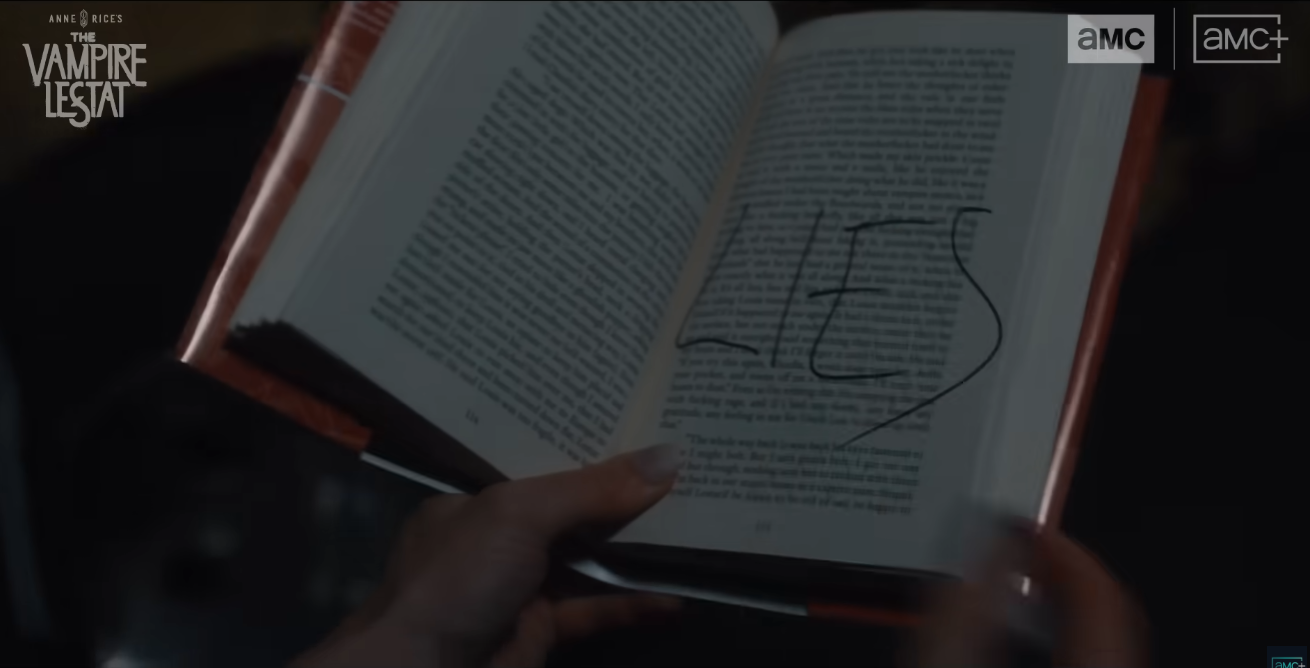
Now, there are two quick shots here that carry a surprising amount of weight, both appearing just as Lestat delivers the line about a rewrite.
The first is more concert footage, but not like anything we’ve seen so far. This isn’t Lestat on stage, adored and untouchable. Instead, he uses the Cloud Gift to rise up to Louis, who is seated on the balcony, holding up a copy of Interview with the Vampire.
And Louis looks… devastated, honestly.
There’s a sadness there, unmistakable, but also that same stubborn resolve he’s always had, present there in the set of his mouth. It says he’s not going to be the one to break first.
Then the trailer cuts again and, this time, Lestat is signing a copy of the book. But instead of his name, he scrawls one word across the page:
LIES.
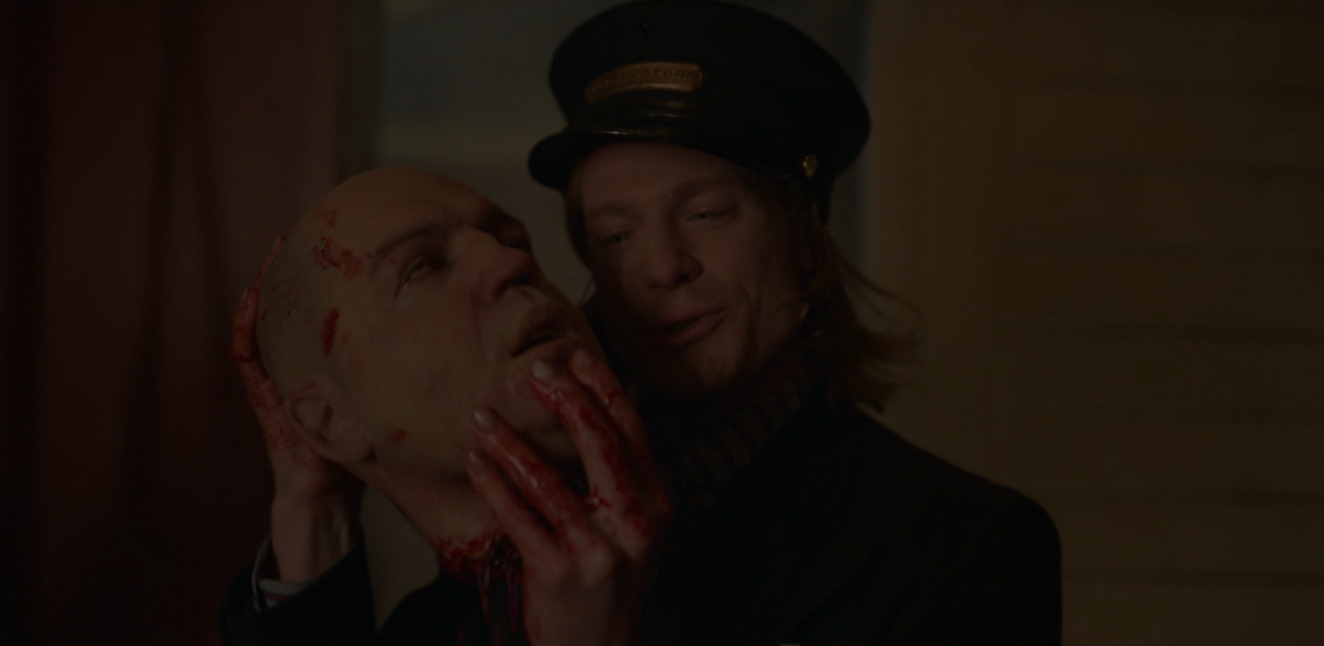
And the page he writes on matters because it’s the train scene pulled directly from Season 1, Episode 6 (“Like Angels Put in Hell By God”), the scene where Claudia tries to run away, only for Lestat to find her, threaten her, and drag her back home. It’s one of the most chilling moments in the series, not because of what they as vampires do to humans, but because of what they do to each other.
As an audience, we understand the vampires are “bad” because they kill. We don’t, typically, care about that. But for them to do harm to one another is where our concerns lie. And this particular scene is one of the worst moments of the vampires doing harm to one another.
This particular version of the event, as it appears in the book, likely comes from Claudia’s diaries. Louis wasn’t there. He can’t confirm or deny it.
So this becomes a question of perspective: Lestat versus Claudia. And Lestat’s answer is simple.
Lies.
But that certainty is… suspicious.
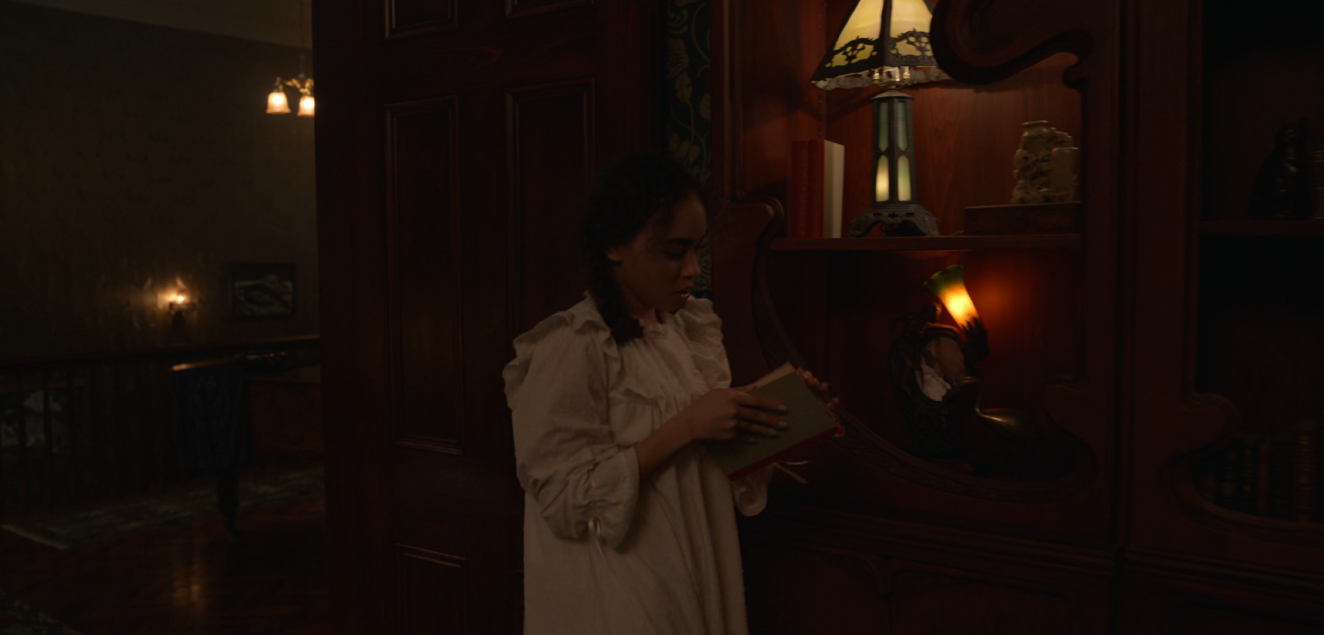
Claudia may be capable of her own kind of cruelty, but her diaries were never meant to be seen, and certainly were never meant for publication. The idea that she would fabricate something like this, in private, feels unlikely.
This suggests something else entirely, then, which is that Lestat doesn’t remember it the way it happened. Or, perhaps more accurately, he remembers it in a way he can live with.
Because from his perspective, there is justification. Panic. Fear. A belief that he was protecting them — protecting Louis, especially, given how deeply Claudia’s absence had already affected him, but also protecting Claudia because he was the only one who truly knew of the dangers out there that could have awaited them.
But intent doesn’t erase impact. Claudia’s reality appears to tell a very different story, and one that Lestat may finally be forced to confront, especially when you consider his own human past, namely his attempts to escape, to carve out a life beyond his family, only to be hunted down and dragged back by a father who ruled through fear and control.
The parallel is hard to ignore.
And if this season is truly about a “rewrite,” then moments like this will have to be reckoned with.
“Everything dies. You die, I die.”
As we close out this breakdown of the first minute of The Vampire Lestat trailer, an unknown voice delivers this line just as “Dancing With Myself” cuts to an eerie halt. What follows is a striking shift in tone and in Lestat himself.
The camera tilts to reveal him lying on the ground, face streaked with dirt or ash, blue eyes slowly opening. And this version of Lestat feels incredibly different from any we’ve seen so far.
To me, this moment points directly to his turning at the hands of Magnus.
There are a few reasons for that. First, we know his turning is one of the most traumatic events of his life and, therefore, something the series is going to show in all its horror. Second, when his eye opens, it’s unmistakably vampiric, not the softer blue we associate with a human being. And third, in the source material, Magnus’ death by fire immediately follows Lestat’s transformation (84), making the ash-covered imagery feel deliberate rather than incidental.
Then the trailer cuts again.
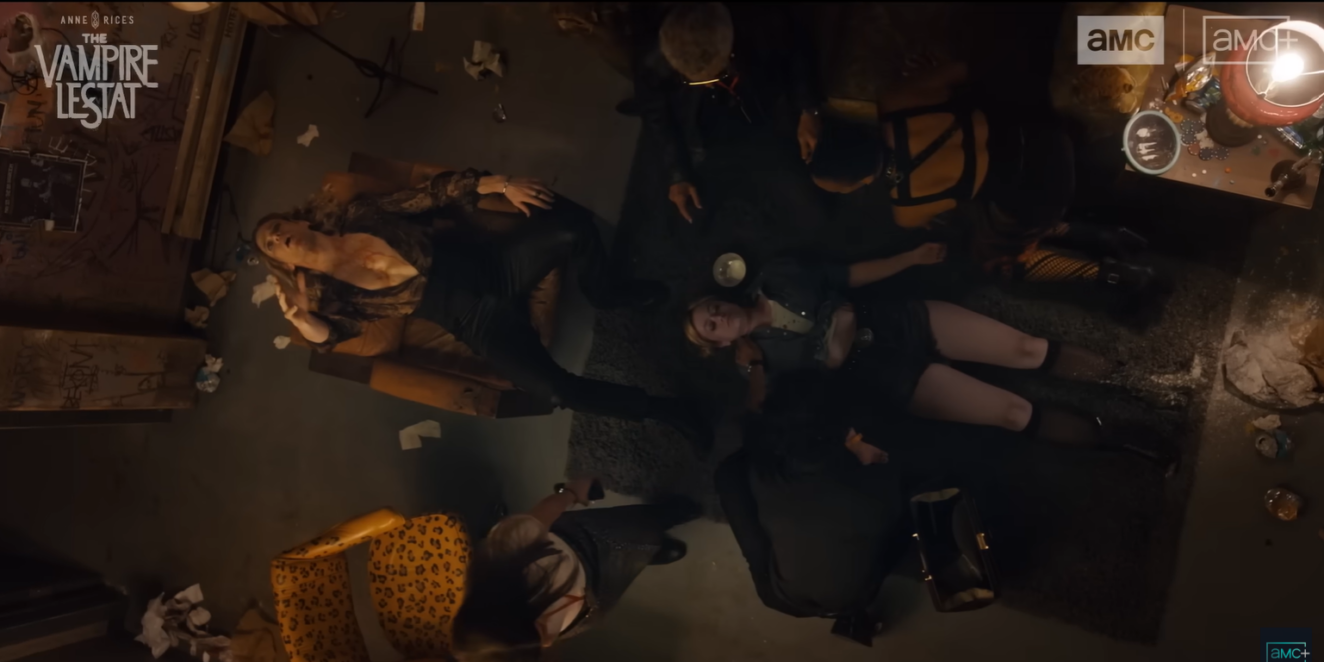
We’re back in the present, or at least, in that same disoriented, drugged, rockstar-era Lestat we saw earlier. But this time, the frame widens. Bodies are scattered around him.
And near his feet is Baby Jenks (Ella Ballentine).
For book readers, her presence is… a little unexpected. Baby Jenks doesn’t appear in The Vampire Lestat, but later in The Queen of the Damned (1988). Still, her inclusion here isn’t random. She’s tied to Lestat’s rockstar era, and her appearance signals something the show has repeatedly done which is pull threads from other novels.
But there’s a whole lot more to unpack with her, and since she shows up again in the second minute of the trailer, we’ll save that for Part 2.

Somehow, all of that is just the first minute.
If this opening stretch makes anything clear, it’s that The Vampire Lestat isn’t easing us into anything. The fun, electrifying rockstar persona is just one of many masks — both the show’s and Lestat’s — concealing the deeper horrors of memory, trauma, and perspective waiting beneath the surface. What we’re seeing is carefully constructed disorientation: every image feels intentional, even without full context, and every line hints at a version of Lestat far more complicated than the one he’s presenting to the world.
Which means the second half of this trailer won’t just expand on what we’ve seen, but will challenge it, layering in even more doubt, intrigue, and horror.
We’ll be tackling the next minute soon — and trust me, it doesn’t get any less chaotic.
Follow along with us at iHorror for all things The Vampire Lestat as we gear up for its June 7 premiere on AMC and AMC+.
TV Series
Friday the 13th Delivers Big News for ‘The Vampire Lestat,’ Including New Song, Title Sequence, and Premiere Date
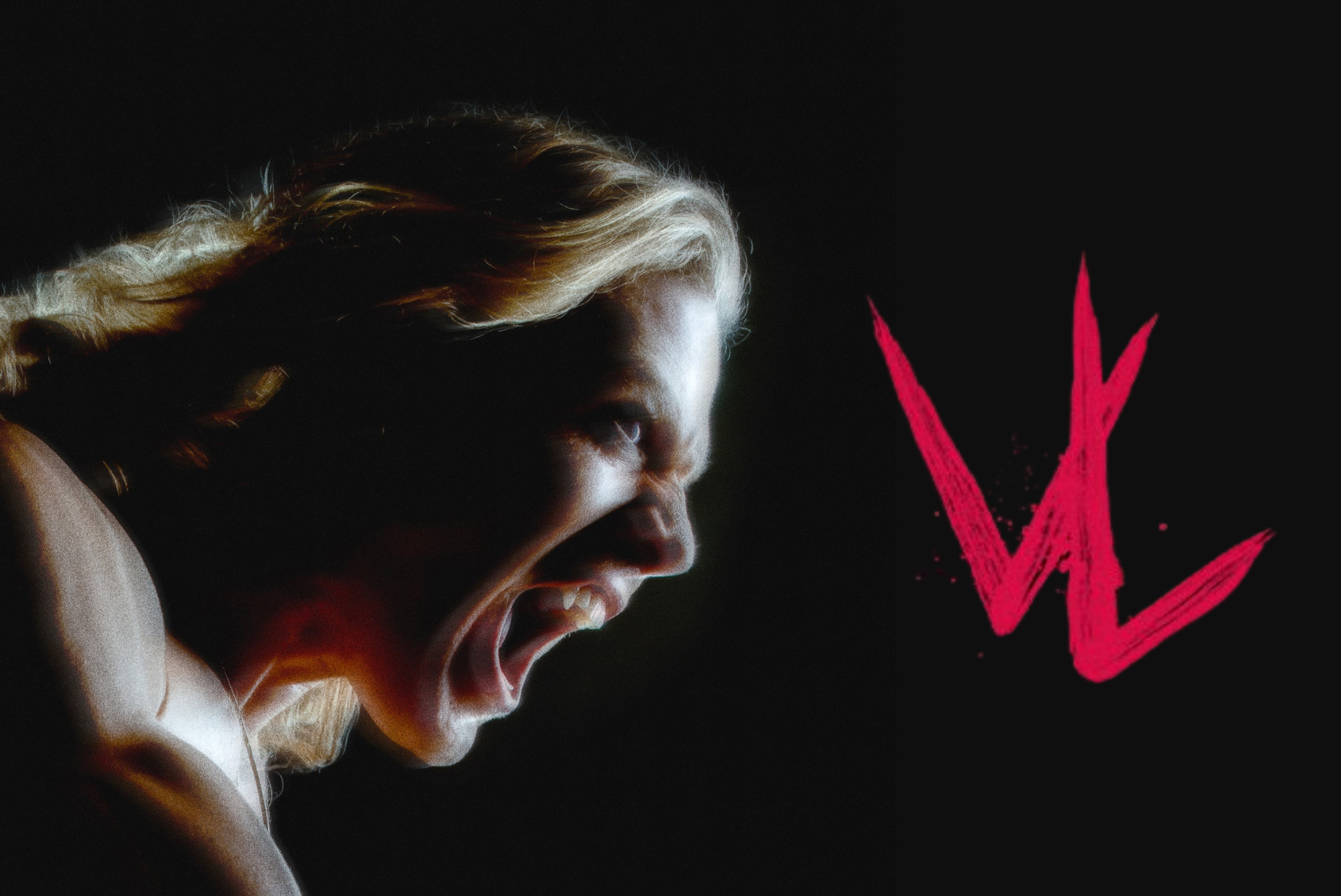
Friday the 13th is proving to be a fruitful time for fans of AMC’s Interview with the Vampire, now retitled The Vampire Lestat for its upcoming third season.
Last month, on Friday the 13th, The Vampire Lestat released the first official single from the vampire rockstar himself, “Long Face.” The track arrived alongside a press release written in Lestat’s unmistakable voice, in which he took a few delightfully snide shots at his collaborator, the incredibly talented composer Daniel Hart. (We’re still #TeamDanielHart over here, by the way.)
Now, on another Friday the 13th — this time in March — AMC has delivered three new confirmations at once.
First, a brand-new single titled “All Fall Down.”
Second, the official title sequence for Season 3, which features “All Fall Down” over a frenetic, electric montage of scenes and imagery (including the Toronto skyline, where the entirety of Season 3 was filmed). The sequence is a chaotic burst of color and performance, dominated by a shirtless rockstar Lestat de Lioncourt (Sam Reid) who takes up the spotlight. It all culminates with the burning green eyes of Louis de Pointe du Lac (Jacob Anderson) — and a cloud-gifted, airborne Lestat.
And finally, the biggest news of all:
AMC’s The Vampire Lestat will officially premiere on June 7.
That’s less than three months away, which is a stretch of time that somehow feels like both an eternity and incredibly close.
There was also yet another press release from Daniel Hart and the Vampire Lestat himself:
Said Daniel Hart: “’All Fall Down’ is both the title track for the new season and the idea for a song by the Vampire Lestat from early in the band’s life. Much like ‘Long face’, it feels heavily influenced by Bowie, T. Rex, and other 70s rock’n’roll stars who were looking back to the blues as much as they were looking up to the stars for inspiration. ‘All Fall Down’ marks a time in this vampire band’s life when they were still figuring out exactly what their sound was, and before Lestat himself started to change personas and explore other musical styles. At the same time, with ‘All Fall Down’, we tried to capture the overall feeling of this new Lestat we get to know better and better throughout the season: more wild, more raw, more self-deprecatingly funny than ever before.”
Said the Vampire Lestat: “’All Fall Down’ is mercifully only 68 seconds long. That’s 54 seconds more Daniel Hart than anyone should suffer. I like the harmonies on the chorus. I did those.”
The Vampire Lestat might be the next big thing, but that ego of his might prove to be his PR downfall.
Just two weeks ago, the first official clip from the new season premiered during IGN Fan Fest. The scene revealed Lestat de Lioncourt and Louis de Pointe du Lac flirting over FaceTime — something that likely brought every Loustat fan to a complete stop before they (or maybe it was just us) screamed.
But that flirtation doesn’t last long.
Notifications begin lighting up Lestat’s iPad (a sentence strange enough to type on its own), revealing something far more troubling: an author profile for Daniel Molloy (Eric Bogosian), whose book Interview with the Vampire is now sitting on bookstore shelves everywhere.
An enraged Lestat storms into his nearest bookstore in Montreal to pick up a copy, very much mirroring the moment from the 1985 novel The Vampire Lestat. Once inside, however, things only get worse as he overhears bookstore workers discussing Armand with far more…affection than they have for him.
To say he’s unhappy would be an understatement.
Interview with the Vampire is, after all, the infamous interview Louis gives to Daniel as they revisit the story he first began telling in 1973. But the version that finally reaches the public is, no doubt, anything but straightforward. By the end of the second season, Louis attempts to destroy the interview entirely, hoping to erase the story rather than see it published. Instead, the book still finds its way onto shelves, and what the public reads is not exactly what Louis originally said, nor a complete version of the truth he himself only begins to understand in the Season 2 finale.
Now, with The Vampire Lestat arriving this summer, audiences will finally see what happens next.
For those looking for answers — for Lestat’s side of the story, for the continuation of Louis’ journey, and for more of those Loustat moments — we finally have a date to look forward to.
June 7.
We’ll definitely be seeing you there.
The Vampire Lestat will premiere on AMC/AMC+ on June 7, 2026. Keep your eyes on iHorror for all the news about it!
TV Series
The Rock God Era Begins in Fiery New ‘The Vampire Lestat’ Clip

The Vampire Lestat, the third season of AMC’s Interview with the Vampire, is officially set to premiere in June 2026.
On February 25, IGN Fan Fest kicked off promptly at 1:00 p.m. ET/10:00 a.m. PT, launching a packed showcase of exclusives spanning film, television, and gaming. For vampire fans, the promise of a The Vampire Lestat exclusive was more than welcome after months of brief teasers released since filming wrapped in October 2025.
For lack of a better description, The Vampire Lestat is a new interview.
The first two seasons of AMC’s critically acclaimed series followed Louis de Pointe du Lac (Jacob Anderson) as he reckoned with fractured memories, buried truths, and the devastating realization that the story he told — and believed — was incomplete. Those seasons largely adapted the first novel in The Vampire Chronicles, the 1976 book that introduced Anne Rice’s lush, violent, and philosophically tangled vampires to the world and reshaped vampirism forever.
When The Vampire Lestat novel was published almost a decade later in 1985, it flipped the narrative perspective. Lestat de Lioncourt stepped forward to tell his own story so that he could both challenge Louis and reveal everything he hadn’t (or wouldn’t) before.
The television series appears to be following that same vein, and the new clip that premiered at IGN Fan Fest makes that very clear.
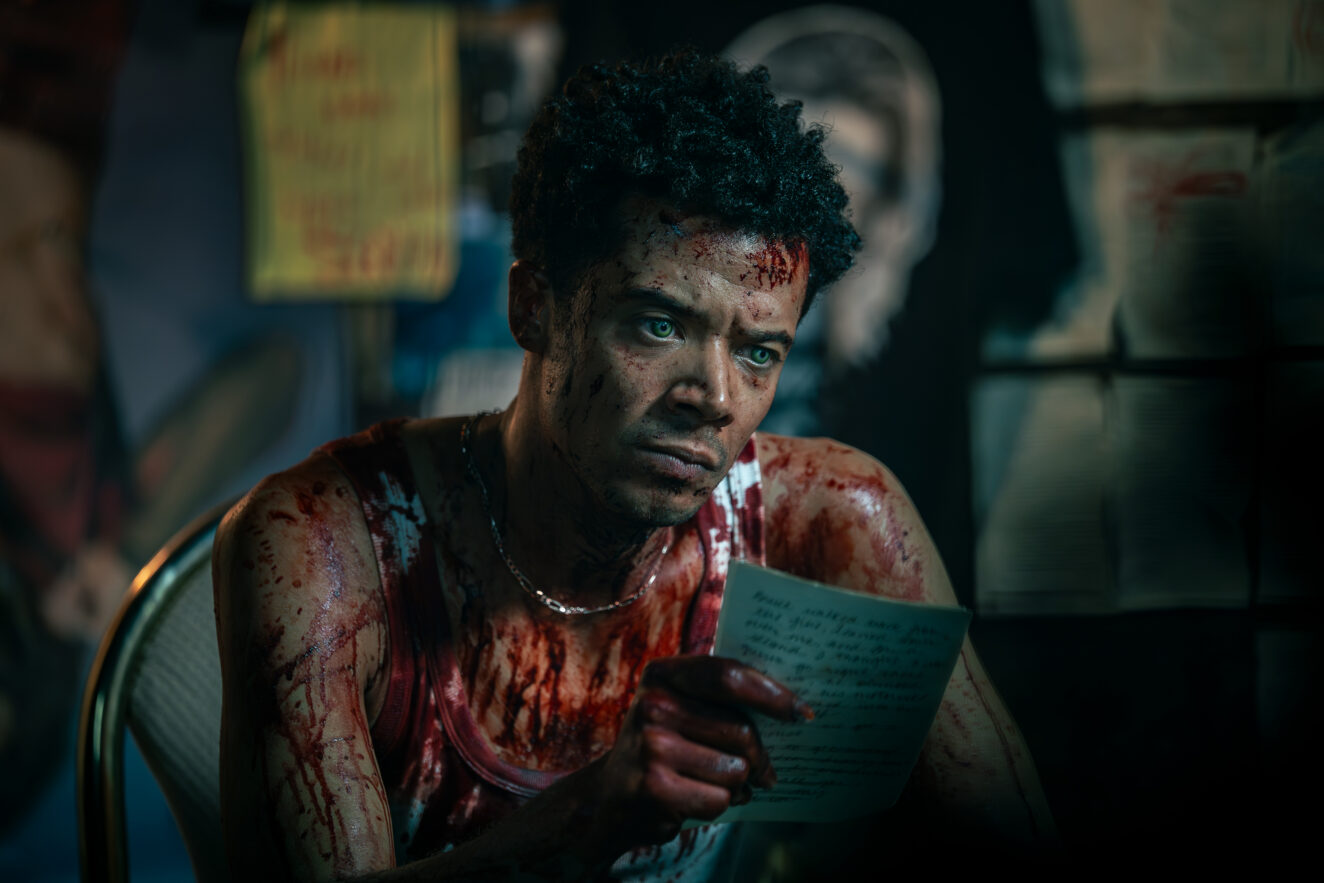
Season 1 of Interview with the Vampire opens with journalist Daniel Molloy (Eric Bogosian) arriving at Louis’ (or, more correctly, Armand’s (Assad Zaman)) elusive Dubai penthouse for a second attempt at an interview abandoned almost fifty years earlier. Louis claimed to be seeking “truth and reconciliation.” By the end of Season 2, that truth had clawed its way into the light, and it was anything but simple. The finale closed with Louis reuniting with Lestat (Sam Reid), Daniel’s unexpected vampiric turning at the hands of the ever-manipulative Armand, and Louis seemingly ending the interview for good by burning the tapes and the laptop that contained it all.
Of course, he hadn’t accounted for cloud storage.
The new clip opens intimately: Lestat seated at a piano, humming as he works out a melody. He’s on FaceTime with Louis, and it’s a delightfully surreal image, these ancient vampires navigating modern technology. Their exchange is easy, familiar, and charged with something stronger than admiration but not something either would, at this moment, admit to be love. Lestat asks Louis what he thinks of the song. Louis offers an opinion. Lestat deems it too simple. Louis clarifies, amused and affectionate.
Then comes the invitation.
“You should come visit,” Lestat says. “I have a space above the bed in one of the guest rooms I can’t find a painting for.”
“Oh, the guest room?” Louis replies. “You want me to come and see your guest room.”
The flirtation is obvious, and it’s tender, and it feels like the precipice of something fragile and hopeful. And yet — as with everything between them, it cannot remain uncomplicated for long.

Mid-conversation, Lestat pulls up a link to an entertainment website spotlighting a bestselling author: Daniel Molloy, writer of Interview with the Vampire.
He asks Louis if he knows who Daniel is.
And from there, it all unravels.
Within moments, they’re arguing. A moment later, Lestat is shown in a bookshop, picking up a copy of Interview with the Vampire while employees casually chatter about wanting to sleep with Armand — Louis’ lover and companion of more than seventy years. The sting is immediate and layered: betrayal, jealousy, fear.
It’s a pointed callback to the 1985 novel. On page 12 of the first edition, Lestat, upon introducing himself to a band he wanted to meet, finds they are familiar with the name Lestat and, specifically, a vampire named Lestat.
“From the other room they brought it, a small pulp paper “novel” that was falling to pieces…I got a preternatural chill of sorts at the sight of the cover. Interview with the Vampire. Something to do with a mortal boy getting one of the undead to tell the tale. With their permission, I went into the other room, stretched out on their bed, and began to read…And when the night was empty and still, I heard the voices of Interview with the Vampire singing to me, as if they sang from the grave. I read the book over and over. And then in a moment of contemptible anger, I shredded it to bits.”
The Vampire Lestat by Anne Rice, Page 12.
His anger is personal, but it’s also existential. The vampires have laws, and the greatest of them is secrecy. As Lestat explains in the novel, “Because if there is one law that all vampires hold sacred it is that you do not tell mortals about us.” Louis’ confession is not just reckless; it’s extremely dangerous. Others will come for him.
That fear — for Louis’ safety, for their exposure, for the fragile order of the vampire world — is what propels Lestat toward fame. It drives him to become a rockstar god who can seize control of the narrative before it destroys them both, and to step into a role that’s always existed within him, but is now necessary: the one who will stand in the spotlight, take the fire, and ensure that no one ever hurts Louis again.
The IGN Fan Fest clip solidifies that turning point. We are watching the moment Lestat realizes the story is no longer contained and he decides to deal with it. Loudly.
And perhaps the most thrilling thing of all: we now have confirmation of a June 2026 premiere.
What The Vampire Lestat ultimately has in store — musically, emotionally, catastrophically — remains to be seen. But if this clip is any indication, the new and old interviews are both truly just beginning.
Watch the new IGN exclusive clip of The Vampire Lestat below.



Horror Coming to Streaming in May 2026: Shudder Is Doing the Most and Netflix Finally Showed Up

Evil Dead Burn Looks Like the Most Violent Family Reunion You’ll Ever Attend

_CIVILIAN Is the Micro-Series That Proves You Don’t Need Much to Make Something That Matters

Breaking Down the First Minute of ‘The Vampire Lestat’ Official Trailer: What It Reveals About Season 3

Jessica T Deveraux Got Possessed At Her Own Bar In New Film ‘Key of Bones’

The Cape Fear Trailer Is Here. Javier Bardem Built It.

iHorror Exclusive Clip: ‘Obsession’ in theaters May 15th

This Week in Horror: The Genre Says Goodbye to Jonathan Tiersten

Sleepaway Camp Knew Before I Did: The Legacy Johnathan Tiersten Left on Queer Media

Koji Suzuki Built the Well. The Author of ‘Ring’ Trilogy Dies at 68

Panic Fest 2026 Review: ‘Creature Of The Pines’ Is An Interesting Found Footage Horror That Walks A Beaten Path

Jonathan Tiersten’s Greatest Role, and it isn’t Sleepaway Camp

Ready or Not 2: Here I Come Blu-ray Review: Buy It for Samara Weaving

Universal’s Horror Make-Up Show Ends 36 Year Run

Self Driver Runs Out of Road

10 J-Horror Films to Watch After Losing Koji Suzuki
Sleepaway Camp Knew Before I Did: The Legacy Johnathan Tiersten Left on Queer Media
Koji Suzuki Built the Well. The Author of ‘Ring’ Trilogy Dies at 68
This Week in Horror: The Genre Says Goodbye to Jonathan Tiersten

Panic Fest 2026 Review: ‘Jump Scare’ Is A Metal As Hell Kick To The Skull!
Jessica T Deveraux Got Possessed At Her Own Bar In New Film ‘Key of Bones’
The Cape Fear Trailer Is Here. Javier Bardem Built It.
-
 News6 days ago
Jessica T Deveraux Got Possessed At Her Own Bar In New Film ‘Key of Bones’
-
 News7 days ago
The Cape Fear Trailer Is Here. Javier Bardem Built It.
-
 News6 days ago
This Week in Horror: The Genre Says Goodbye to Jonathan Tiersten
-
 Editorial4 days ago
Sleepaway Camp Knew Before I Did: The Legacy Johnathan Tiersten Left on Queer Media
-
 News4 days ago
Koji Suzuki Built the Well. The Author of ‘Ring’ Trilogy Dies at 68
-
 News6 days ago
Panic Fest 2026 Review: ‘Jump Scare’ Is A Metal As Hell Kick To The Skull!
-
 Lists3 days ago
10 J-Horror Films to Watch After Losing Koji Suzuki
-
 News1 day ago
Universal’s Horror Make-Up Show Ends 36 Year Run
You must be logged in to post a comment Login