

You Might Be the Killer is a brilliant meta-horror comedy from writer/director Brett Simmons (Husk, Animal) that flips the script on horror tropes. Starring Fran Kranz (The Cabin in the Woods) and Alyson Hannigan (Buffy the Vampire Slayer), it’s a deliriously delightful love letter to the slasher genre.
The film is based on a hilariously spot-on twitter thread between writers Chuck Wendig and Sam Sykes (click here to read it in full) that quickly went viral. In the thread, Sam finds himself trapped in a summer camp where counsellors are dropping like hacked-and-slashed flies, so he reaches out to his buddy Chuck for some sage advice. During their conversation, Chuck guides Sam to the unsettling realization that he might actually be the killer.
I recently spoke with Brett Simmons and Fran Kranz at the Toronto premiere for You Might Be the Killer, where we discussed the genesis of the film, the challenges of being a slasher killer, and their deep love for the horror genre.
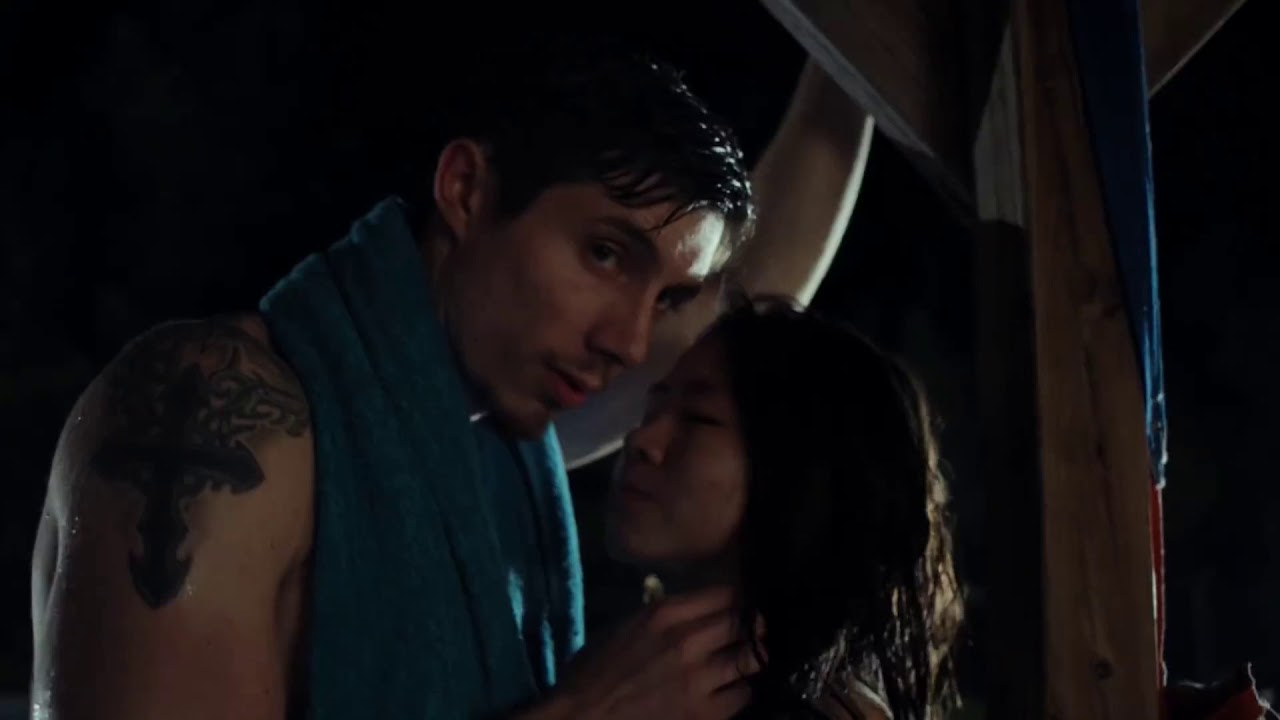
Kelly McNeely: So, You Might Be the Killer started as a twitter thread between Sam Sykes and Chuck Wendig, how did that develop into the film that it is now?
Brett Simmons: Oh god, well, I mean, it was really daunting at first because I was just like “why are we dipping into twitter to find our movie ideas?”, but then when I read it I was like ok, I get it.
One of the things I noticed really quickly was that it was only like 60 tweets long, but there are very specific story revelations that play out throughout the conversation. I went ok, so here’s your act break, and here’s your mid point, and here’s your third act, and kind of more just delineating the information that plays out in that conversation, and how to frame a story around it. So honestly, the most daunting thing was thinking about it before we started.
But once we started, it began to kind of find itself a bit better. The twitter conversation isn’t that long and we have a 90 minute movie, so Tom Vitale and I – he’s a producer and co-writer – when we were writing, we were tasked with creating a lot of conversation that didn’t yet exist between Chuck and Sam that still had their voice and maintained their chemistry and kind of the comedy of it.
Sam and Chuck were still so passionate about it and wanted to be involved that we were able to send them pages and they would tweak things here and there, so it was cool. It was really fun to be able to collaborate with them in that way because I felt like they were able to hold us accountable to making sure that Chuck and Sam sounded…

Kelly: Like Chuck and Sam, yeah.
Fran Kranz: I came on just on the screenplay, I never read the twitter conversation because it was too long. [all laugh]
Brett: [jokingly] Too many tweets.
Fran: No, but it’s funny because, sadly, I haven’t met Chuck and Sam – the real guys.
Brett: I actually haven’t either.
Fran: Oh you haven’t either? Interesting.
Brett: I think one lives in Indiana, and one lives in Oregon?
Fran: Ok, sure, yeah. But I’ve been joking that now I, you know, resent them. It’s our movie now, Brett and I –
Brett: [all laugh] You’ve taken over, we don’t need them anymore.
Fran: I came on it with this great screenplay, you know, it was sent to me and then I got on the phone with Brett… and I’ve been saying it’s so funny – so consistently funny – that my big concern was, does the movie have any stakes? If it’s just kind of a joke – so self-aware – does it turn into this horror film analysis or a comedy sketch of a horror film.
But Brett and I were immediately on the same page with ideas on how to keep it grounded, how to sustain a kind of pace that won’t be distracting, that won’t ever let up so that the jokes don’t become distracting and kill the stakes and the sense of consequence in the world.
So I feel like – as funny as it is – it feels like a world where life and death situations are happening, and they matter.
Kelly: The stakes are very real, absolutely.
Fran: Yeah.
Kelly: So how did Alyson Hannigan come on board for the film?
Brett: Same as Fran, we sent her the script. What was funny was we sent her the script and her agent warned us ahead of time, like, look, Alyson has a family and she doesn’t really like to do horror movies anymore, I wouldn’t hold your breath. I was just a fan and it felt like an inspired choice, so we just took a gamble.
But she ended up really responding to the friendship that Chuck and Sam had, which really was the heart of the whole movie and that’s what was most important to me. I feel like if we fail at everything else, we’ve succeeded if Chuck and Sam are believable friends, and we believe about them caring for each other. She really loved that, and so it was great because once she came on, she had a lot of ideas of her own and was ready to just come and play.
The thing that I liked was – we have a pretty bold introduction to Sam… Chuck, we don’t. Chuck’s just in the comic shop. So Alyson brings a lot of instant likability where it’s just like, we know she’s safe and we like her, so we can be on board with this as quickly as I wanted the audience to be on board with it. And she does love the genre, so she herself is so knowledgeable. She was just perfect.
Kelly: I love how much chemistry exists between the two characters, even though they’re never in the same room at all.
Brett: Never!
Fran: I know, it’s amazing! Isn’t that amazing?
Kelly: It’s all just over the phone, but you’re immediately like, “I… get this!”

Brett: We’ve been talking about this, and I’ve gotta say, because I know it’s so funny, Fran was never in the same room with her. He came on set to say hi one time, but they were never acting in the same scenes.
And to me that’s just such a testament to [Fran] and Alyson’s ability, because there’s so much chemistry – that one-sided chemistry – that exists in the editing for me… my job was so easy because it was all there. They created a chemistry that otherwise shouldn’t exist. [laughs]
Fran: It’s funny, I’m wondering if there’s some unconscious Joss Whedon school of acting going on or something, you know what I mean? [all laugh]
Kelly: It’s that wavelength, yeah.
Fran: It was a funny thing because I did come to set to hang out and say hi, and then kind of attempted to read lines off-camera, and if anything, I wasn’t sure it was helpful.
We both were very confident in what it needed to be and understood how we would have to play off each other. But I think sort of knowing the reality of filmmaking and that we weren’t going to be there, it almost seemed unhelpful to be there and try and force it in. And knowing the sort of range we needed to give Brett, and they were able to find it in editing.
But it’s a testament to her talent that she was able to create that performance, because I think it’s harder for her. I feel like, actually, it was easier to be playing the high tension and fear on the phone call, there’s sort of less to do with that in a weird way. Whereas Chuck might have a harder role with playing reaction to that.
She has to be funny and relaxed and kind of comfortable in her element, but not deny the truth of what Sam’s going through, you know? It’s a much harder job, I think, and she does an incredible job with it.
Brett: That’s actually a really good point, because that was my biggest challenge.
I felt like Fran’s biggest challenge was that we were meeting him in the third act of the movie, so from day one Fran was having to show up to set to get covered in blood and play like his world was ending, and that’s a very tall order for a feature film right out the gate. Just like, “alright, so, you’re at an 11, and… go”. Whereas Alyson wasn’t necessarily at an 11, but she was tasked with teetering some of the tricky tone.
Fran: Yeah, real tricky.
Brett: In the sense of, like, she can’t love this so much that she looks like she’s a closet murderer, or like she’s an accomplice to evil, but at the same time she has to also have a familiarity with it where we think she enjoys this without feeling like she’s homicidal. And she cares for Sam.
It was really tricky! I actually – even in the script – was just wrestling with her verbage on so many things that by the time we got to set, she just kind of found it really naturally that I was like [sigh of relief]. It was the hardest thing for me about all of her stuff.
From the beginning of the movie when Sam’s on the phone and says “There’s a serial killer” and she goes “OH”, and her reaction is perfect! And I don’t know what that reaction was going to be that made sense, because, like, there’s a version where you look sick, there’s a version where you don’t look invested, and you need to be both, so where does that lie?
Kelly: It’s hard to find that level of emotional investment – like you said – for someone that’s excited for this, but also does not want this to happen, but is kind of in the back of their mind like [restrained fist pump].
Brett: Yeah! It’s really tricky, yeah. Even moments where, like, you know “oh that was cool, but I shouldn’t be excited right now”.
She has that line where Sam’s on the one side of the phone like, “oh god, this is horrible, I’m so sorry to drag you in to this” – it’s like the friend saying “man, you’re bailing me out of jail, I’m so sorry” – and she says “oh don’t worry, you know I live for this stuff”. But they’re just in two completely different worlds.
Fran: It reminds me of Indiana Jones with like, dangerous supernatural relics, you know? She recognizes the danger, but she’s very interested in studying them too.
Brett: Like “isn’t it kind of amazing how this killer…”
Fran: Right, she’s concerned for all the natives, but she’s still gonna… bring it to a museum, I dunno. [all laugh]

Kelly: Speaking of getting involved, with the “behind the mask” scenes, Fran, was that all you? Did you have someone else coming in and doing those bits?
Fran: We’d talked about it early on. Isaiah LaBorde who’s a producer on the film – he actually did like 20 different things. I don’t know how – [to Brett] how is he credited?
Brett: He’s credited as a producer.
Fran: And a stunt man?
Brett: And a stunt man.
Fran: Ok, ok. That’s it?
Brett: He plays The Shape of the… I think the killer was referred to as The Wood Carver in the credits? This was not approved by me, so if you like it, I know it, but if you don’t, I did not know it. [all laugh]
Fran: That’s funny he’s called The Wood Carver.
Brett: He doubled in. But it was funny because – so there are a lot of factors going in to the shoot where I knew as a director that Fran was going to be taxed.
We had a very short schedule – we had the shortest schedule I’ve ever had as a director, which was a little daunting. Which meant we were going to need to shoot a lot, or shoot a lot per day.
But also, I just was really concerned about the volume of emotion and stuff that Fran was going to have to be dealing with. So we were trying to figure out what the best way was to pull off this killer in such a way that Fran was still alive and breathing at the end of our shoot.
One of the things that really worked out magically for us was that Isaiah – who is a stunt man – he was on board as our stunt coordinator. We had no idea, but he’s actually of a very similar build and stature to Fran.
So we kind of created this rule book of, if the killer’s going to be very physically active, we’re just going to have the stunt coordinator do the stunts because he looks like a possessed postured version of Sam. It’s like a Jekyll and Hyde thing where the posture is ever so slightly – he doesn’t feel himself, but he also still appears like himself. So it was really subtle. But then the other thing was if the killer was still going to be emoting in any way, then that was going to be Fran.

Fran: Yeah, we did little transitions, so if it goes Isaiah to Fran, then back to Isaiah or whatever, we could just play with it, and they obviously found it in editing.
But it’s true, I mean I hate to admit it, but I don’t know if I could have done this movie if I did every sequence with the mask on. Because yeah, it was a lot of 90-100 degree days in Louisiana summer humidity, and covered in blood.
I remember our first day was – like [Brett] said- the movie begins at an 11. It’s the third act, he’s covered in blood, screaming and running for his life, and we came in and were shooting some of those scenes on the first day so we just came in hot, and I realized very quickly that oh, god, this is going to be really hard. I think I went home and had, like, Pedialyte and couldn’t move the next day, you know what I mean?
So I was like, I don’t know how I’m going to do this, I was concerned. So there was a little bit of that, I think it was just practical. But I think it’s really an amazing thing. Isaiah has a more intimidating, athletic posture, which was a really cool trick we have. And I don’t think it’s necessarily noticeable. I’ve watched it with people and it doesn’t occur to them that it’s two different actors.
Brett: I think there’s a subtle, but you maybe feel a little bit of a difference even though you don’t necessarily acknowledge it. And all of our gore was practical, so there’s a lot of very specific, technical, precise actions that we needed to do, and I was also concerned about putting that on Fran on top of memorizing all of his dialogue and running and everything else he was going to do. The head chop, for example…
Kelly: Yes! Yeah.
Brett: That was one of those things where – like an idiot – I told him I wanted him to start a few feet away and then charge in and attack, not thinking about how much harder I was making the job of chopping a really precise point, because he basically had to chop the head within like half an inch of the mark or the gag wasn’t going to work. Like, it had to just hit this one point.
And so I was just like, this is going to be impossible, and Isaiah’s great, he did it on the first take! He just practiced and practiced like a martial artist [mimes lining up a hit], and did it! And it was awesome.
But that’s the type of thing that I don’t know how I could ask [Fran]. He was able to rehearse that for hours, whereas with Fran it would have been like, “ok man, so throw that mask on and dive in!” [all laugh]
Kelly: And I like that, because again, it had not occurred at all – which is why I asked – that it would not be you for the whole thing, but it makes sense. And it kind of feels like that different personality. Like when it takes over, it takes over.
Fran: Yeah! And it’s funny, I remember when I saw it in Austin and I said to someone before the film, “yeah, I’m basically covered in blood for the whole movie”, and I was surprised by how many times I’m not! I spent a lot of time in the flashback where I’m like, oh, ok!
Brett: [jokingly] I don’t remember that!
Fran: Yeah, my memory of it is a little different, but yeah, it was a super fun shoot, but challenging that way. So it was physical.

Brett: It was hard!
Fran: Yeah, super physical.
Kelly: You Might Be the Killer is such a love letter to the genre, there’s a ton of little hidden homage moments, lines that are dropped – mentioning Maniac Cop, things like that. How much of that was written in to the script, and how much of that came in when you were designing the production?
Brett: That’s a good question. Most of Chuck’s stuff was – anything she says was written. I’d like to tell you that we had an incredible budget and I could design whatever I wanted, but I couldn’t. So a lot of it was just coming in with an intention of, what can we get a hold of that emulates this?
I tried desperately – I was on the phone with Paramount trying to get the rights to the Friday the 13th poster, because I wanted that to be one of the posters that Chuck referenced, but I could not get it.
But the Monkey Shines toy was there, and the quote on the mug… but there’s a lot of little winks and nods. I think my favorite is actually not even a horror movie nod.
In the comics shop there’s a poster of Stephen Furst as Flounder from Animal House, and that was a spiritual cameo for Stephen because his son, Griff, is the producer on the movie.
Kelly: Oh that’s fantastic!
Brett: So Curmudgeon Films is Griff’s company which he essentially inherited from his dad, who is no longer with us. So when we needed to decorate this comic shop with pulpy pop culture stuff, I just, for Griff, was like, let’s put a poster of Flounder in the background. He didn’t know I was going to do it. But that’s one that has nothing to do with horror, but it was sentimental.
Kelly: It sets the tone really well, too.
Brett: Yeah, it’s a family affair.
Kelly: Yeah! And there’s one pool scene and – I don’t know if this was intentional – but I thought, oh this is like The Mutilator in a big way.
Brett: Yeah! One hundred percent, yeah. And another one I thought was going to be a blatant homage that not everybody’s picked up on is the shed scene.
I have a very guilty pleasure love for Halloween H20, and when Michael is stabbing at Laurie through the gate, I just always loved that. So we were at the shed and, like, “we need some kind of action here”, and I thought, let’s do this H20 thing I remember. So that was kind of an homage to that.
Kelly: Yes! Agh I think I’m out of time…
Brett: No, you’ve got one more question!
Kelly: I do have one more question. So, Fran, you’ve got a lot of history with the genre between Bloodsucking Bastards and The Cabin in the Woods, and now You Might Be the Killer, obviously. Were you a fan of horror when you were younger, or did that come later?

Fran: Yeah! I’ve always loved horror films. I think they scared me – they truly scared me as a kid. I think I saw them as something of a challenge, you know? Maybe it bothered me a little bit, and maybe I was embarrassed by it, but there was something fascinating about this kind of power they had.
So I’ve always been really interested in the genre, and I think it was later – maybe highschool or college – that I was able to appreciate the comedy of it. We would go through marathons of the Friday the 13th movies… one thing when you’re a kid, they’re scary, later in life they’re absurd, and you’re like, wow these are the funniest movies I’ve ever seen! [all laugh]
So I’m not sure if the comedy aspect of horror was as purposeful when I first got it, but certainly I remember when Scream came out, and obviously Cabin in the Woods, I thought, this is genius, this kind of satire of it.
So yeah, basically to answer your question, yes! I’ve always been a real fan of it. I think there’s something compelling about dealing with your fears or embracing what you fear and sort of expressing it artistically. I think it’s just a way we exercise it, so to speak, and understand it, you know? I think it’s a way to kind of conquer your fears.
I guess the same is said for comedy, I think that’s also how we deal with things. They’re both kind of survival mechanisms and they work so well together because of that. When they’re working together and they’re at their best, there’s nothing like it.
Kelly: Yeah, they’re kind of two sides to the same coin – that light and dark, it’s building the tension and releasing it.
Fran: Yeah, I totally agree.
Brett: I’ve always felt like comedy and horror are the same as far as setup, delivery, punchline, but the difference is that the punchline is either a scream or a laugh. But they function similarly, you know? The design is really the same.
Be sure to stay tuned to iHorror for my upcoming full review of the film! For more iHorror interviews, click here to read our conversation with Christine McConnell about her new Netflix series, The Curious Creations of Christine McConnell


